Built for the Next Generation NCLEX

An NCLEX-RN® question bank that measures before it teaches.

Cytross Nursing estimates your ability question by question, allocates each practice batch toward what you have practised least, and reports readiness as a band with its uncertainty — not a point score pretending to be precise.

Live domains
5live domains
Next-Gen item types
11Next-Gen item types
Clinical judgement steps per case
6judgement steps per case

Domains currently live

  • Nursing Foundations & Leadership
  • Adult Health
  • Child Health
  • Maternal / Newborn
  • Mental Health

The difference

Most question banks count. This one estimates.

A percentage correct tells you what happened. It does not tell you what you know, how confident that reading is, or which question to answer next. Cytross Nursing is built around the estimate rather than the tally.

Adaptive practice

You set the size. The engine sets the mix.

Pick how many questions you want and, if you like, which domains to draw from. The engine allocates the batch across those domains and tilts it toward the ones you have practised least. Choose whether feedback arrives after each question or all at once at the end.

Adaptive exam

A real adaptive test, not a timed quiz.

One question at a time, each one scored on the server so the next is chosen from what you have actually demonstrated. The exam stops when the estimate is statistically separated from the standard, then returns pass or fail with the confidence interval behind it.

Next Generation NCLEX

Every Next-Gen item type, in unfolding case studies.

Case studies unfold across a client record — nurses' notes, vital signs, laboratory results, orders, diagnostics — and ask you to work it the way the exam does. All eleven item types are implemented as first-class interactions, not as multiple choice in disguise.

  • Matrix multiple choice

    One choice per row across a fixed set of columns.

  • Matrix multiple response

    Any number of columns per row, scored cell by cell.

  • Extended multiple response

    Select all that apply from a long grouped list.

  • Highlight

    Mark the relevant phrases inside a note or a table.

  • Bow-tie

    One condition, two actions to take, two parameters to monitor.

  • Drag-and-drop cloze

    Drag tokens into the blanks in a clinical sentence.

  • Drag-and-drop sorting

    Order the steps, or sort findings into the right bucket.

  • Drop-down cloze

    One blank in the stem, resolved from a list.

  • Drop-down cloze, multiple

    Several dependent blanks in one passage.

  • Drop-down rationale

    Dyad and triad items linking a finding to its cause.

  • Drop-down table

    A drop-down per row of a structured assessment table.

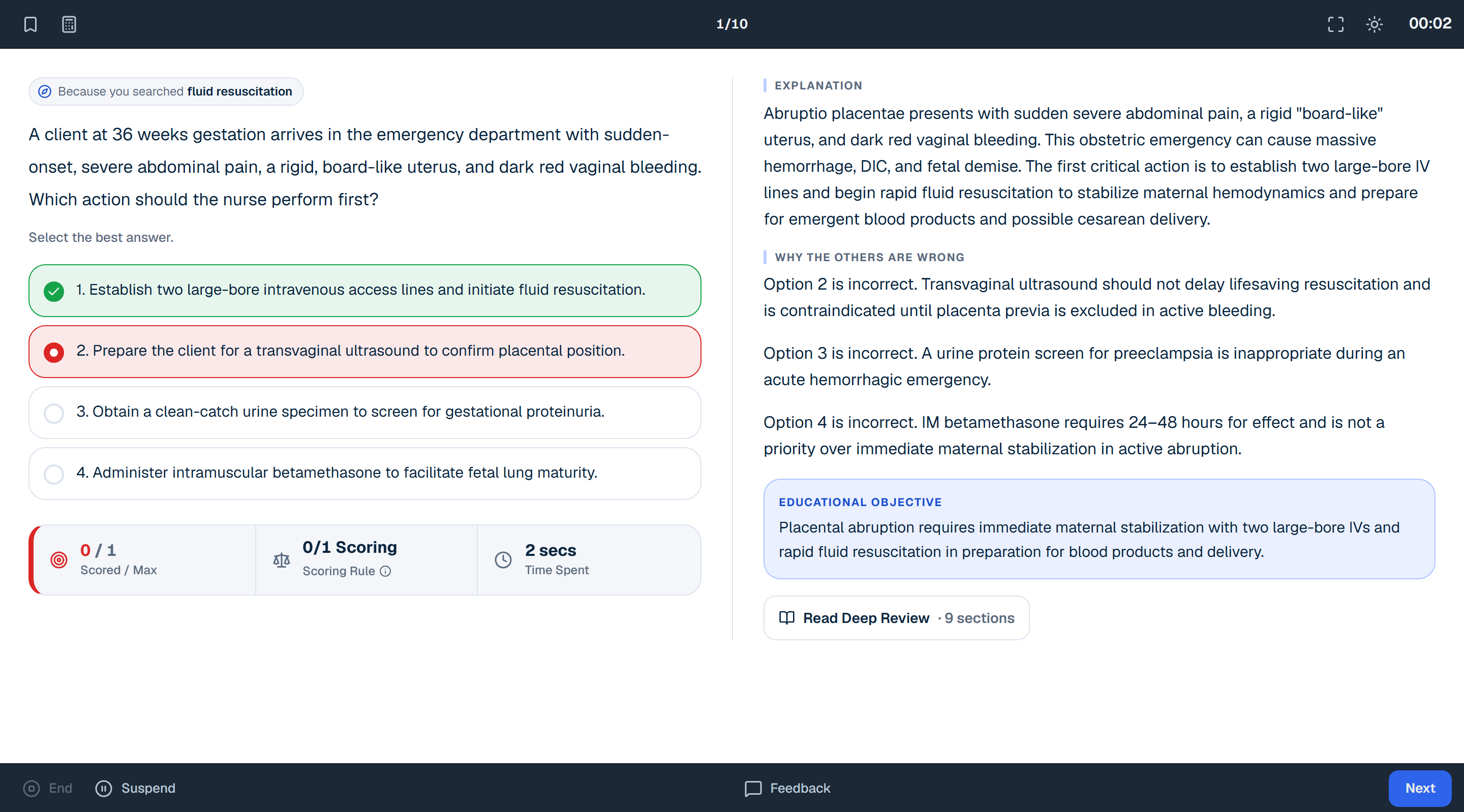
Partial credit is applied per item type: plus-minus scoring where the exam uses it, all-or-nothing where it does not, and per-row or per-cell scoring for matrix and table items. After you submit, the score you earned, the rule that produced it, and the time you spent are shown above the rationale.

Measurement

A band, with its error bars, beats a number you cannot trust.

A single readiness percentage implies a precision no question bank has. Cytross Nursing reports where you sit as a band, and shows how wide the estimate still is — so you can tell the difference between “you are close” and “we do not have enough evidence yet”.

  • Readiness band

    Your overall position, reported as a band rather than a score, and never as a prediction of your result.

  • Safety-True band

    A second band weighted toward items where a wrong answer would put a client at risk, so a comfortable average cannot hide an unsafe pattern.

  • Per-cell mastery, with uncertainty

    Every domain and system carries its own estimate and its own interval. Thin evidence looks thin.

  • Error taxonomy, speed and accuracy

    Misses are classified by the kind of mistake they were, and pace is reported alongside accuracy so you can see which one is costing you.

After the answer

A rationale for the question. A lecture for the concept.

Getting an item right for the wrong reason is worth almost nothing on exam day. Every question carries a rationale that explains the key and the distractors, and behind it sits a full Deep Review lecture on the underlying concept.

Per-question rationale

Why the key is the key, and why each distractor is not — written against the cues in the stem, not as a summary of the topic.

Deep Review lecture

The full teaching behind the item: the pathophysiology, the priorities, and the pattern that generalises to the next question on it.

Save to your library

Bookmark any lecture to a personal notebook, tagged with its topic, domain, and system.

Search what you saved

Your library is searchable, so the lecture you read three weeks ago is one query away rather than lost in a scroll.

Study with other people

Preparation is easier when it is not solitary.

  • Friends

    Find people by their public handle and send a request. Your email address is never exposed to other users.

  • One-versus-one duels

    Challenge a friend head to head on the same set of questions and compare how each of you answered.

  • Share invites

    Invite someone with a subscription-share link. Invites are single-use and expire.

No testimonials yet

We would rather show you nothing than show you something invented.

Cytross Nursing is new. We have no pass-rate statistic worth quoting and no student quotes we have permission to publish, so this space is empty on purpose. When there are results and consenting students behind them, they will appear here with their methodology attached.

In the meantime, the honest version of the pitch is the product itself. Create an account and answer twenty questions.

Find out what you actually know.

Create an account, run one adaptive batch, and read the report. If the estimate is not more useful than a percentage, nothing here will change your mind.